




Gold has been the center of fascination for humanity for thousands of years. Gold is a status symbol that represents beauty and longevity. However, the value of gold has also made it a subject for deception. From gold-plated jewelry to other complex gold alloys, everything is being presented as pure gold.
For all those who are in possession of gold jewelry or planning to buy gold jewelry, especially precious items like gold necklaces, it is very important to understand how to check the authenticity of the gold.
While the only reliable method is to get the gold appraised by a professional, there are a number of tests that can be carried out at home to determine the authenticity of the gold.
Understanding Gold Purity and Types
Before you begin testing, it helps to understand what you’re looking for. Pure gold, known as 24-karat gold, is 99.9% gold but is too soft for most jewelry. Therefore, gold is typically alloyed with other metals like copper, silver, or zinc to increase durability and alter its color, resulting in yellow, white, and rose gold variations.
The karat (K or kt) system measures purity, with 24 karats being pure gold. Common purities include:
- 18K Gold Contains 75% pure gold.
- 14K Gold Contains 58.3% pure gold.
- 10K Gold Contains 41.7% pure gold.
Crucially, your necklace might not be solid gold at all. It could be:
- Gold-Plated: A very thin layer of gold electroplated over a base metal like brass or copper.
- Gold-Filled/Rolled Gold: A thicker layer of gold mechanically bonded to a base metal, offering more durability than plating.
- Vermeil: Sterling silver coated with a thick layer of gold, usually 14K or 18K.
Initial tests to check the authenticity of gold
To check the authenticity of gold, there are a number of methods that you can use. Below, we will introduce these methods.
Look for Hallmarks and Stamps
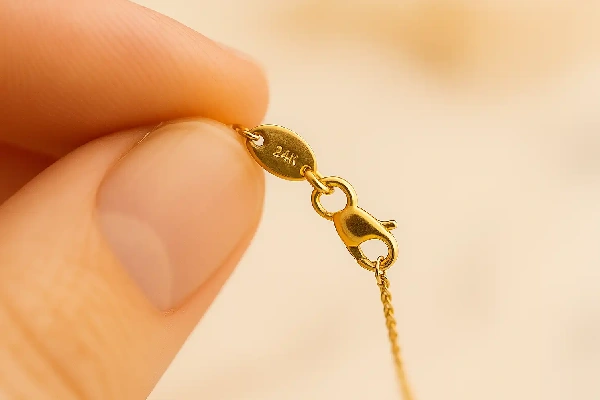
The first and easiest thing you can do is to check if your necklace bears some markings, especially on the clasp. For instance, Check if your gold jewelry bears numbers such as “24K,” “18K,” “14K,” or “10K.” There may also be other markings such as “417” (which stands for 10K gold, or 41.7% gold content), “585” (which stands for 14K gold, or 58.3% gold content), or “750” (which stands for 18K gold, or 75% gold content).
Assess the Color and Heft
Examine the piece for discoloration. If the necklace shows blackish tarnish or if the gold color has worn away in high-friction areas (like the back of a pendant or the inner part of a chain), revealing a different-colored metal beneath, it is likely gold-plated. Gold is a dense, heavy metal. Compare the weight of your necklace to another piece of similar size you know to be gold. Real gold necklaces are usually heavier than imitations of the same size.
The Magnet Test
Hold a strong neodymium magnet near your necklace. If it is attracted to the magnet, it is not pure gold – it probably contains iron, nickel or other magnetic metals, as gold is not magnetic. However, note that not being magnetic does not prove that it is gold, as many non-magnetic base metals such as copper or lead can be used in counterfeit jewelry.
The Density (Float) Test
This test leverages gold’s high density (approximately 19.3 grams per cubic centimeter). drop your necklace into a glass of water. Genuine gold, due to its high density, will sink directly to the bottom. If the piece floats, hovers, or sinks very slowly, it is not real gold.
The Ceramic Scratch Test
Use an unglazed ceramic tile or plate (the underside of a coffee mug often works). Gently rub the gold item across the ceramic surface. Real gold will leave a golden-yellow streak. A black or gray streak indicates the piece is not genuine gold, as the base metal is being exposed. Perform this test gently and in an inconspicuous area to avoid unnecessary scratching.
Chemical Reaction Tests
These experiments involve observing the chemical inertness of gold, and therefore, should be performed in a well-ventilated area.
The Vinegar Test
Place your gold in a small bowl, cover it with white vinegar, and let it sit for 5-8 minutes. Remove and rinse it with water. Real gold will not react or change color; it will maintain its shine. If the metal darkens or changes color, it is not pure gold.
Gold Skin Test
This traditional test is less common but still has some uses. The idea is that real gold is relatively inert and won’t react with your skin chemistry. Some suggest applying a light layer of liquid foundation or moisturizer, letting it dry a bit, and then applying the gold to your skin. Real gold is said to leave a dark streak in makeup. Similarly, if a necklace consistently leaves green or black stains on your skin, it likely contains copper or other base metals that are oxidizing.
When should I look for specialized methods to identify gold?
The above methods can provide good clues about whether gold is fake, but they have limitations. Professional testing is essential to confirm these tests, especially for valuable, antique, and semi-precious pieces like necklaces. Jewelers use advanced, often non-destructive techniques such as:
- X-ray fluorescence (XRF): A handheld analyzer that provides a precise breakdown of the metal’s composition in seconds.
- Electronic testers: Devices that measure electrical conductivity to determine the purity of the gold.
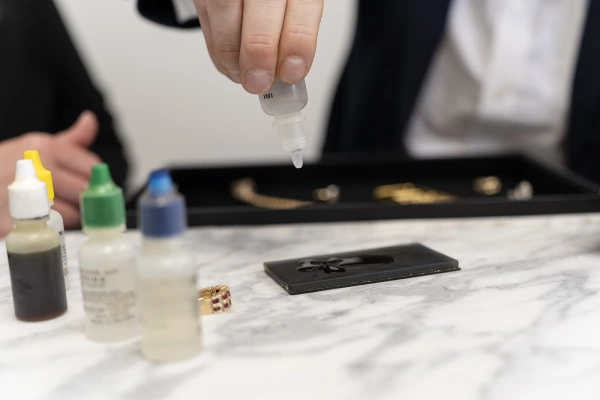
- Acid/touchstone test (professional grade): A more precise version of the acid test in which a streak of the item is created on a touchstone and treated with acids of specific concentrations to determine its exact fineness by comparing the reaction with the reaction of control needles.
These methods eliminate guesswork and provide a reliable assessment.
Conclusion
Learning to test gold at home will enable you to own authentic jewelry. Start with a visual inspection for obvious signs, then move on to appropriate physical tests such as the magnet test and density test. For a more detailed examination, ceramic and vinegar tests can provide more detail.
For a professional appraisal or to inspect a new set of authentic gold jewelry, contact our experts at our Marysa collection.